
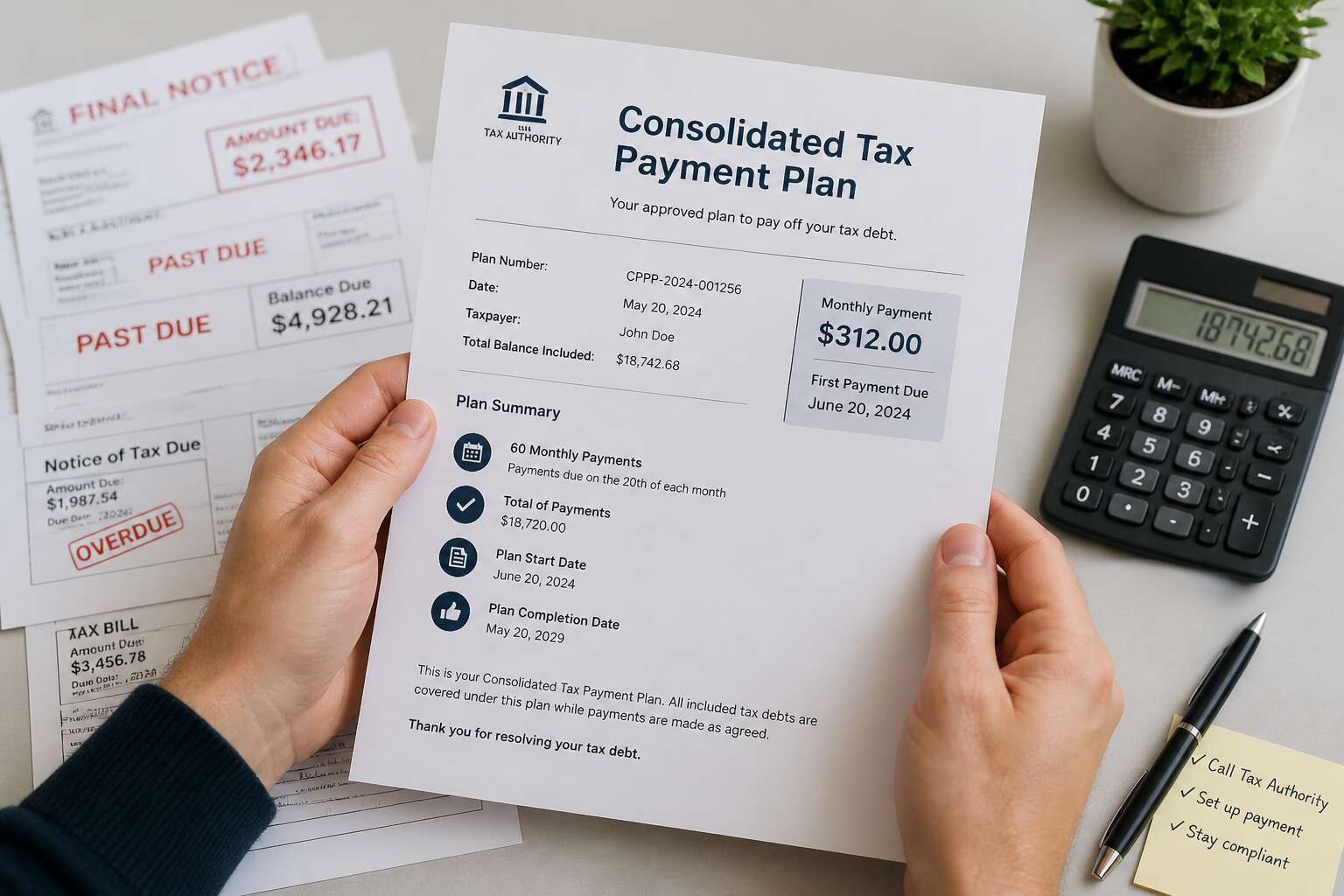
Understanding the Full Scope of Your Outstanding Tax Obligations
Gathering up-to-date IRS transcripts and balance due notices
Your tax burden has a shape you may not recognise. Many South Africans only focus on the final amount on their due notice, ignoring the trail of penalties and interest that built it. Pulling up-to-date SARS transcripts reveals that trail. Request your statement of account and any balance due notices from the last three years.
Here is what to look for:
- Original tax amounts for each year
- Penalties and interest applied after each deadline
- Payments made and how SARS allocated them
Without this complete record, you cannot judge the true scale of your obligations. Tax debt consolidation depends on knowing the exact total. Gather these documents first, then compare them with your own records. The differences often explain why your balance refuses to shrink.
Breaking down how interest and penalties compound monthly
Here is the part that catches people by surprise. Interest on unpaid tax does not sit still. It compounds monthly, meaning the interest itself earns interest. Your balance grows from two directions at once.
- Monthly interest on the original amount
- Monthly interest on the accumulated interest
- Penalties levied on the unpaid principal
Consider R100,000 in unpaid tax with a 10% annual rate. Year one adds R10,000. Year two adds interest on R110,000, not R100,000. That gap widens every month, which is why tax debt consolidation needs the full total, not the figure from an old notice.
Distinguishing between federal, state, and local liabilities
South African tax obligations arrive in layers. SARS collects income tax, VAT, and corporate assessments at the national level. Yet municipalities impose their own burdens through property rates and service levies. These local debts operate on separate timelines and carry their own penalties.
Many taxpayers consolidate only the national figure and miss the rest. A complete picture requires:
- SARS assessment balances and payment plans
- Municipal property rates and arrear levies
- Provincial or regional taxes where applicable
Each layer demands attention. Tax debt consolidation fails when it excludes any portion of your obligation. You need certainty about every account before negotiating.
Recognizing common reasons for unanticipated tax debt
Tax debt rarely announces itself. It accumulates quietly, through provisional tax underestimates, business cash flow shortfalls, or a single missed filing that triggers cascading consequences. The true scope of what you owe often exceeds the figure on your initial notice.
Consider the moments that create unanticipated liability:
- An audit that reclassifies prior deductions
- Directors who treat company funds as personal income
- VAT returns submitted with honest but incorrect input claims
Each scenario produces a balance that feels foreign. Tax debt consolidation requires facing this complete figure, not the comfortable version. The full obligation, once measured, becomes the foundation for resolution.
Negotiating Directly with the IRS for a Manageable Plan
Applying for a short-term installment extension of 120 days
The IRS rarely volunteers flexibility. You have to ask for it. A 120 day installment extension offers a reprieve without the bureaucracy of a long term agreement. You call, you explain your situation, you receive a deadline. That deadline is not a threat. It is a fixed date you can plan around.
I have negotiated these extensions for clients who owed amounts they thought impossible to manage. The process demands precision. You need your figures ready. You need to know what you can pay each month. The IRS agent will calculate, verify, and decide.
For some taxpayers, this short window is enough to arrange tax debt consolidation through other means. Others need the extension simply to gather funds without penalty escalation. Either way, the 120 day option remains a direct path to stability, and for many it becomes the first step toward tax debt consolidation.
Creating a long-term monthly payment agreement based on your budget
Many taxpayers assume the IRS dictates payment terms. In reality, the agency listens when you present a clear budget. A long-term monthly agreement requires honesty about your income and necessary expenses. You lay out your numbers, and the IRS compares them against their own collection standards. This is negotiation, not pleading. Your proposal must show you cannot pay more without hardship.
For tax debt consolidation, a formal monthly arrangement replaces the chaos of multiple notices. Prepare these figures:
- Monthly income after statutory deductions.
- Essential costs like housing, transport, and medical aid.
- A realistic payment amount that leaves no room for default.
The IRS agent may counter with a higher figure. Push back if it breaks your budget. The goal is an agreement you can sustain for years. This negotiation prevents bank garnishments, which arise when tax debt consolidation turns reactive. Many South Africans with US tax obligations find this process restores control.
Submitting an Offer in Compromise and what the application fee covers
The IRS expects a rational conversation. Direct negotiations for a manageable plan require your actual budget, not your fantasy one. Present your monthly numbers without flinching. Tax debt consolidation often stalls when taxpayers overstate their willingness to pay. Don’t do that.
Offer in Compromise allows you to settle your debt for less than owed. The application fee, currently $205, covers processing and a credit check. This fee does not include legal advice or a cuddle. Some taxpayers qualify for a fee waiver, but eligibility is narrow. For tax debt consolidation, this option demands precise paperwork.
- The agent prefers a signed agreement over endless letters.
- Your offer must include documented hardship.
- A rejection leaves room for a revised proposal.
Negotiation works when you control the data.
Requesting penalty abatement through the First-Time Abate rule
Calling the IRS with a prepared script changes the conversation. The First-Time Abate rule allows a one time penalty removal for taxpayers with a clean compliance record. You must show three years of timely filed returns and no prior penalties. I have seen this work when taxpayers come prepared.
The IRS manual instructs agents to apply this relief automatically in some cases, but they often wait for you to ask. A polite request can erase thousands in failure to pay penalties!
- Confirm your compliance history before calling
- Reference the First-Time Abate rule by name
- Request written confirmation of any verbal agreement
Tax debt consolidation becomes more affordable when penalties disappear. Your monthly payment then addresses the underlying balance rather than the extras.
Determining if Currently Not Collectible status is your best option
Negotiating directly with the IRS requires a steady nerve. The agency holds the ledger, but you hold the facts of your own survival. A manageable plan takes shape when you lay bare your income, expenses, and obligations without embroidery. Numbers have their own eloquence.
Currently Not Collectible status, or CNC, stands apart from payment agreements. It halts collection activity while your hardship lasts. The debt does not vanish, it waits. Tax debt consolidation becomes a meaningful strategy when the IRS concedes that demanding payment would leave you unable to meet basic needs.
- CNC requires proof that your expenses exceed your income
- The IRS reviews your status at least every two years
The agency speaks in forms and deadlines. Your voice enters through the documentation you provide.
Using Private Financing to Pay Off the IRS Faster
Comparing personal loans with fixed rates and flexible terms
Borrowing at 7% to clear a balance that carries 10% interest saves money from the first month. That is the quiet advantage of private financing for tax debt consolidation. A personal loan with fixed rates replaces the IRS’s compounding charges with a number that stays still, giving you room to breathe.
Freelancers and farmers often face income that arrives in bursts. A loan with flexible terms lets repayments stretch or shrink alongside the seasons, and some lenders permit early settlement without penalty. The annual percentage rate, origination fees, and total interest over the term decide whether the loan truly helps.
- Fixed repayments protect against future rate hikes
- Flexible terms accommodate unpredictable income
- One consolidation loan replaces multiple collection notices
Tax debt consolidation through private financing works best when your credit record is solid and the total liability fits within a three to five year repayment window.
Unlocking home equity through a HELOC or cash-out refinance
Consider the equity sitting inside your walls. A HELOC or cash-out refinance can convert that dormant value into a weapon against the IRS’s compounding interest. The rates are typically lower than personal loans, and the repayment terms stretch across decades, which softens the monthly blow. Your home becomes the collateral, so the stakes rise alongside the savings.
This approach suits those who own significant equity and face a tax bill that personal loans cannot comfortably cover. Tax debt consolidation through home equity replaces multiple notices with a single, manageable payment.
- A fixed-rate refinance locks your interest, shielding you from future hikes
- A HELOC offers flexible draws, useful if the liability grows
- Interest on home loans may carry tax advantages, depending on your situation
But the IRS can place a lien on that same property if you miss payments, so the calculation must favor certainty over hope.
Weighing the tax implications of a 401(k) withdrawal or loan
Private financing through your 401(k) can settle the IRS faster. But the tax implications demand scrutiny. A withdrawal triggers ordinary income tax and a 10% early distribution penalty if you are under 59 and a half. That extra liability could undermine your tax debt consolidation strategy. A loan, by contrast, avoids immediate taxes, yet you repay with after tax dollars, and defaulting converts the balance into a taxable distribution.
Consider the trade offs:
– A loan keeps your retirement growth intact, but requires payroll deductions.
– A withdrawal simplifies the transaction, but shrinks your nest egg permanently.
Weighing these options within your overall tax debt consolidation requires a careful review of your cash flow and retirement timeline. The IRS only cares about the balance due, not the source, so private financing buys time without altering your existing obligations.
Hiring a Professional vs. Handling Your Own Resolution
Knowing when a tax attorney can protect your assets and future income
The distinction between saving a few rand and losing your financial footing can be measured in the silence of a single wrong decision. Handling your own resolution might feel like reclaiming control, but the South African Revenue Service operates on a procedural certainty that rarely accommodates emotional attachment to what you owe. When you choose to go it alone, you are betting your future income against your understanding of complex liability rules, often without the leverage to negotiate effectively.
This is not about intelligence. The psychological weight of a looming debt figure alters judgment. You might accept a payment plan that strains your cash flow, simply because an official letter demanded closure.
A tax attorney, however, is a transactional mercenary. They do not feel the sting of the balance or the guilt of the overdue notice. They see the architecture of the debt, not the moral failure you might attach to it.
The professional response to tax debt consolidation offers a specific kind of protection:
– Immediate intervention to halt garnishment orders on your salary
– Strategic negotiation that prioritizes the preservation of your primary residence
– Legal separation of personal liability from business insolvency risks
– A clear analysis of prescription periods that might invalidate older claims
Without this oversight, an individual often prioritizes the loudest demand rather than the most dangerous one. You might pay off a small, aggressive collector while SARS quietly applies interest to a far larger, dormant liability. The professional sees the complete picture. They know when to present a case for compromise and when to simply shield your assets from seizure, allowing you the breathing room to rebuild without the constant psychological erosion of a government claim. That protection is not a luxury. It is the structural difference between resolving a debt and surrendering to it. Tax debt consolidation, when managed by a professional, becomes a defensive strategy rather than a desperate plea.
How an enrolled agent can negotiate directly with IRS collection divisions
When you handle your own resolution, you are speaking to a call centre. You are explaining your situation to someone who follows a script, not someone who holds the authority to reshape your liability. A registered tax practitioner, by contrast, sits on the other side of the relationship. They can negotiate directly with the SARS collections division, bypassing the layers of anonymous procedural response.
That difference changes the outcome of tax debt consolidation from a gamble into a calculated strategy. A professional knows which levers pull quietly and which ones demand documentation. They do not waste your time with generic promises; they arrive with your file, your history, and a precise understanding of what SARS can legally enforce.
- Direct access to senior collections officials rather than front-line clerks
- Immediate verification of whether your account is already flagged for attachment
- Authority to request internal reviews before a garnishment order is issued
For someone trying to manage alone, every phone call resets the anxiety. For a practitioner, it is just another conversation in a sequence of professional obligations. That is the quiet advantage of letting someone else carry the procedural weight.
Assessing the value of a CPA when preparing financial disclosures
When you manage your own tax debt consolidation, the burden of financial disclosure falls entirely on you. A CPA does not simply fill in blanks. They assess which documents matter and which ones trigger further scrutiny from SARS. That distinction is often the difference between approval and a protracted review.
CPAs understand how SARS reads cash flow statements, asset registers, and expense claims. I have seen taxpayers flag inconsistencies they never noticed. Preparing financial disclosures without professional oversight may expose patterns that invite additional audit activity.
Tax debt consolidation requires precision. A CPA translates your lived financial reality into a format SARS accepts. That translation, when done well, shortens the timeline and removes the guesswork.
Red flags to watch for in predatory tax relief firms
Not every tax debt consolidation process ends with SARS approval. Some end with taxpayers paying a second company for promises nobody can keep. The difference often comes down to who you hire, or whether you hire anyone at all.
Handling your own resolution saves money on fees. It also costs time and patience. A professional knows the internal workflows that SARS uses to process applications. Without that knowledge, a small omission can restart the entire timeline.
Watch for firms that guarantee outcomes. SARS does not guarantee anything. No legitimate advisor can promise that an Offer in Compromise will succeed. If a firm demands full payment before doing any work, do not proceed!
Predatory tax relief firms often share the same traits:
- They ask you to stop communicating with SARS directly
- They quote a flat fee before reviewing your actual tax debt consolidation file
- They pressure you to sign immediately, citing fake deadlines
A genuine professional reviews the numbers first. Then they talk about strategy. That order matters more than most taxpayers realise.
Gathering the right paperwork before you email or call the IRS
Before you approach SARS about tax debt consolidation, the paperwork must be complete. A professional knows exactly which documents SARS expects. A taxpayer resolving their own case often discovers missing forms only after the application stalls.
Your file should include:
- Notice of assessment for the relevant tax years
- Proof of income and monthly expenses
- Bank statements showing the last three months
Professionals build the narrative SARS needs to approve the arrangement. Do it yourself and you accept the risk of omission. Do it with a professional and you buy their familiarity with SARS internal workflows.
Deciding whether a DIY approach makes sense for smaller balances
Smaller tax debt consolidation cases can tempt you to go it alone. The SARS online portal is accessible, and the forms are published. But a professional sees the process differently. They know which collection division handles your file, and they know when silence is better than a proactive call.
Consider your own risk tolerance. If you owe a modest amount and your finances are stable, working directly with SARS may save you a consultation fee. But the trade-off is time and emotional capital.
- SARS requires precise supporting documents.
- One missing schedule can reset the application timeline.
- A professional can spot the error before submission.
When I talk to taxpayers who tried the DIY route, they often say the same thing: the paperwork was the easiest part. The waiting was what broke them.
Rebuilding Stronger Finances After Resolving Your Tax Balance
Adjusting your paycheck withholding to avoid surprises next year
Clearing your tax balance should feel like a weight lifted, yet many taxpayers describe the aftermath as oddly unsettling. The direct debit is gone, but the memory of that financial squeeze lingers. Adjusting your payroll withholding now is not about overcorrecting. It is about recalibrating your monthly cash flow so SARS does not hand you a surprise bill next year. A smaller, consistent deduction protects your budget from a future lump sum demand.
Many individuals who resolved a large liability make the mistake of keeping their withholding structure unchanged. That approach often sets the stage for another deficit. Instead, review your current income tax tables and submit a new IRP3 or employer declaration. This practical step turns your tax debt consolidation efforts into a lasting habit rather than a temporary fix.
When you receive a refund, resist the urge to treat it as disposable income. Consider this:
– Direct the refund toward an emergency savings buffer.
– Use a portion to prepay next year’s provisional tax.
– Invest the remainder in a tax-free savings account.
This approach transforms a passive event into an active financial strategy. Your future self will appreciate the foresight, especially if your income fluctuates. Building a margin between your earnings and your obligations creates space to manage unexpected expenses without resorting to credit. The goal is stability, not perfection.
Finally, remember that tax debt consolidation is most effective when paired with proactive planning. Your revised withholding is a declaration of financial intent. It signals that you are no longer reacting to tax season, but anticipating it. That shift in mindset, supported by a tangible adjustment to your paycheck, is what prevents history from repeating itself.
Creating an emergency fund to prevent future payment gaps
Nothing feels quite like watching that final tax balance vanish from your account. Yet the relief fades quickly when you realize another unexpected bill could push you back into the same situation. Building an emergency fund after your tax debt consolidation is the difference between a one-time crisis and a recurring pattern.
Start with a modest target, even R5000 can buffer a minor expense. Keep this money separate from your everyday spending. A high interest savings account works well. Direct a portion of your monthly income toward it, just as you did with your debt payments.
Consider these priorities:
- Cover three months of essential expenses.
- Set aside money for quarterly provisional tax.
- Add a buffer for irregular income months.
Tax debt consolidation succeeds when you pair it with this emergency reserve. Your future self will face fewer surprises, and your next tax season becomes manageable rather than terrifying.
Monitoring your credit report for errors after settlement
When the final payment clears, the silence feels heavier than the debt itself. Yet a settled balance does not cleanse your credit profile. Errors linger in bureau files, sometimes for years. In South Africa, you can obtain a free credit report from each bureau annually. Request yours from TransUnion, Experian, and XDS. Scrutinise every line. A single incorrect default can raise your bond rate or block vehicle finance, even after tax debt consolidation.
This vigilance becomes the cornerstone of your next chapter. If a balance still shows as outstanding, file a dispute in writing. The bureau must investigate within 20 business days. Follow up. A correction today prevents a denied application next year.
- Confirm the balance reflects zero.
- Ensure the status reads paid, settled, or closed.
- Look for duplicate entries from the same account.
Your credit report shapes every future loan application, just as tax debt consolidation shaped your past. Guard it accordingly.


0 Comments