
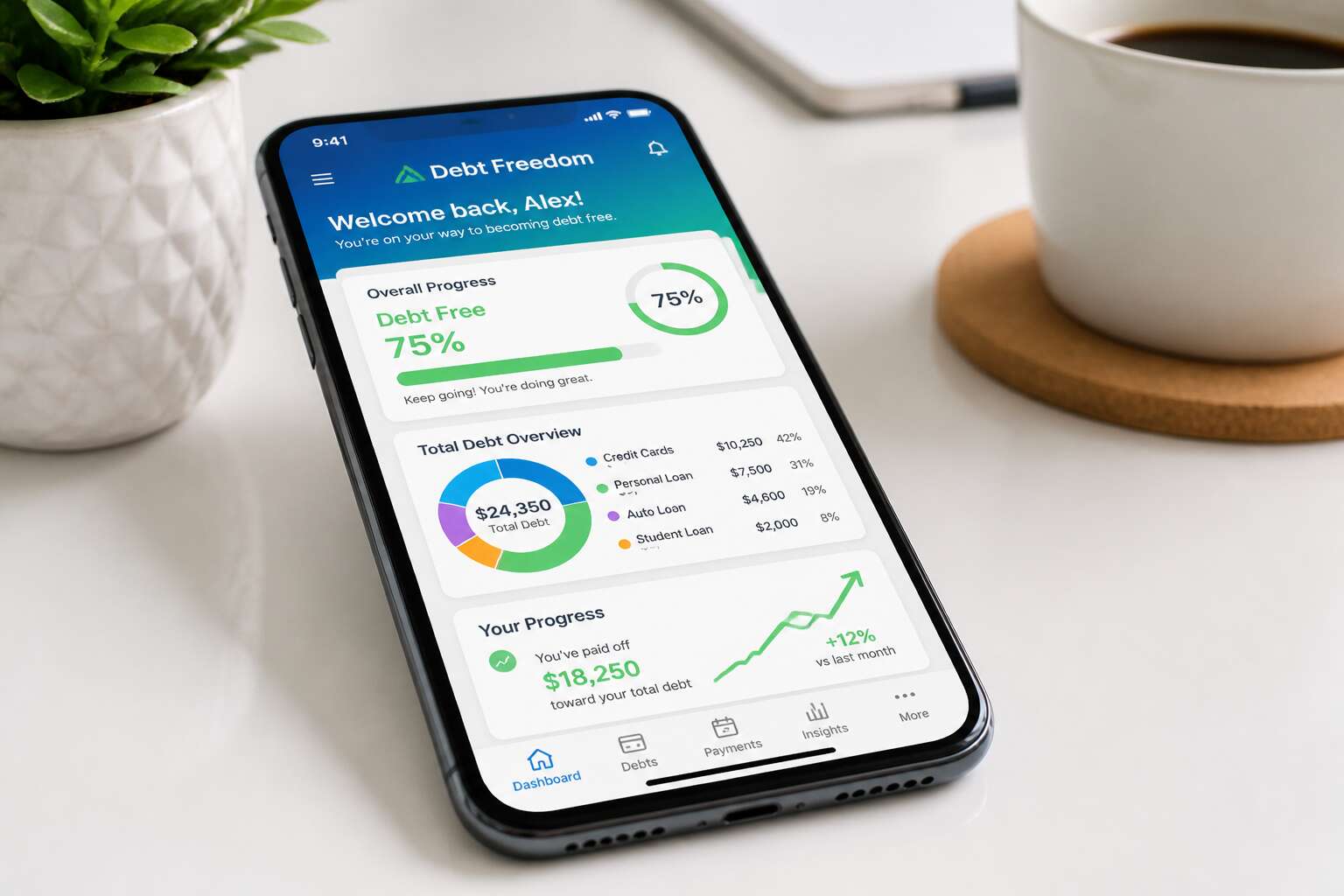
Understanding Debt Consolidation Technology
How Digital Debt Management Works Behind the Scenes
The average South African carries R20,000 in unsecured debt, yet the mechanics of how a debt consolidation app actually processes that burden remains opaque. Behind the interface lies a system that aggregates accounts, calculates interest differentials, and negotiates payment timelines with creditors through secure APIs.
Digital debt management works by pulling live data from your bank and credit providers, then simulating repayment scenarios. The app’s algorithm prioritises high-interest debts while preserving your credit score trajectory. It is not magic; it is mathematics executed at scale.
- It encrypts your financial data end to end.
- It rebalances monthly allocations automatically.
- It sends payment instructions to creditors on your behalf.
This automation reduces human error and eliminates the emotional friction of manual transfers. For South African users, the app must also navigate local payment gateways and legal compliance. I find that is the true innovation of a debt consolidation app.
Key Features of Modern Financial Repayment Tools
Few people talk about the quiet mental toll of managing multiple repayments. A debt consolidation app does more than merge balances; it reorders your financial chaos into a single, predictable rhythm. For South Africans juggling store cards, personal loans, and credit accounts, the technology offers a cognitive reprieve, not just a mathematical one. The true utility lies in its ability to translate complex liability structures into a simple monthly action.
Modern financial repayment tools are designed around behavioural psychology as much as spreadsheets. The prioritisation logic shifts as your salary lands, and the system adapts to your spending patterns without requiring constant oversight. This dynamic adjustment is the key feature that separates a useful tool from a static calculator.
The core functions worth understanding include:
– Automated negotiation protocols that re-sequence payment dates to align with your cash flow.
– A unified dashboard that displays the weighted cost of each debt, removing the guesswork from settlement strategies.
– Local compliance checks that ensure your repayment plan adheres to South African credit regulations.
What impresses me most is the precision of the allocation engine. It does not simply pay the smallest balance first; it calculates the cost of carry across your entire portfolio and directs funds where the interest accrual is most punitive. This approach requires a robust data integration layer, one that reads your bank statements in real time to verify funds availability before any instruction is sent.
The security architecture supporting these features deserves attention. Biometric authentication and tokenised access are standard, but the data encryption at rest is where trust is earned. Your financial footprint is scattered across multiple institutions, and the app acts as a secure intermediary, reducing the risk of manual data entry errors that plague traditional debt counselling. For the user, the benefit is clear: a streamlined, defensible path to financial stability.
The Difference Between Mobile Solutions and Traditional Counseling
The difference between mobile solutions and traditional counseling is a matter of tempo. Traditional counseling involves folders, forms, and waiting rooms. A debt consolidation app compresses that entire ritual into a few taps on your phone. I respect the counsellors who helped South Africans before this technology arrived, but their methods were built for a slower century. The app is not a replacement; it is a shortcut through the bureaucracy.
Consider what the technology changes:
- It verifies your income without a payslip handover.
- It recalculates your payment plan when your salary date shifts.
- It flags accounts that are costing you the most.
None of this requires a scheduled meeting! That speed is the real innovation.
Evaluating Top-Rated Debt Payoff Platforms
Criteria for Selecting a Trustworthy Financial Platform
When you finally confront your debt, the last thing you need is a platform that disappears overnight. South Africans have enough financial uncertainty. Selecting a trustworthy platform starts with verifying regulatory compliance. The National Credit Regulator is your first checkpoint.
Look beyond flashy dashboards. Scrutinise the fee structure for hidden penalties. Read user testimonials on independent forums. A debt consolidation app that promises miracles will disappoint. The right one discloses its algorithms and partner lenders.
- Check if the platform uses 256 bit encryption
- Confirm whether it reports payments to credit bureaus
- Ask for a clear timeline of your payoff schedule
I have seen people lose months to unresponsive support. Trust is built on transparency, not marketing. When a debt consolidation app offers no audit trail, walk away. Your data requires strict protection.
Cost Structures, Subscription Tiers, and Hidden Fees
South Africans mistake the lowest monthly subscription for the cheapest option. A debt consolidation app with a R99 tier may bury its real expense in transaction fees or penalties. I have compared dozens of payoff platforms, and the pattern repeats.
Scrutinise each tier for what it excludes. Basic plans rarely include creditor negotiation, and that service costs a percentage of your enrolled debt. Look for setup charges, monthly maintenance fees, and per-payment costs that appear only after linking a bank account. A trustworthy debt consolidation app discloses these numbers before you commit.
- Compare the effective annual cost, not the advertised fee
- Check whether interest on your enrolled debt accrues daily
- Ask if your debt consolidation app penalises early settlement
One client paid R400 monthly for two years without realising her platform charged an additional R25 for every debit order. The fine print is where the real money disappears.
Security Protocols and Personal Data Protection Standards
Security protocols separate a dependable debt consolidation app from a risky one. I have tested platforms that tout 256 bit encryption, yet their login pages lacked two factor authentication. That gap matters when your bank statements and ID numbers sit on a server. In South Africa, POPIA demands strict handling of personal information, but compliance is not a guarantee of protection.
- Where is your data stored, locally or offshore?
- Who can access your financial records internally?
- Does the app support biometric login and auto logout?
A reputable platform will answer without vagueness. One breach can undo months of repayment progress, so scrutinise the security whitepaper before you commit.
User Experience and Interface Accessibility
A cluttered interface creates friction! When I evaluate top rated debt payoff platforms, I watch how the screen behaves under stress. Does the dashboard load your balances instantly? Can you navigate to a payment schedule without hunting through menus? Accessibility matters beyond font size. In South Africa, where data costs remain high, a debt consolidation app that functions smoothly on older phones and low bandwidth deserves attention.
I look for these markers during testing:
- Does the app render clearly in offline mode?
- Are buttons large enough for thumbs?
- Can a user with visual impairment complete a payment using screen readers?
A beautiful interface means nothing if it fails on a two year old Android. The best platforms prioritise load speed and legibility over flashy animations. When the platform becomes an obstacle, users abandon it. Your repayment journey should feel straightforward and direct.
Customer Support Quality and Measured Success Rates
Support quality is the first thing I interrogate when reviewing debt payoff platforms. I look beyond response times and scripted reassurance. I want to know if a human can explain my amortisation schedule without condescension. In South Africa, where financial stress runs deep, empathy is infrastructure.
Measured success rates matter equally. A debt consolidation app should publish realistic outcomes, not vanity metrics. During evaluation, I check how platforms report progress. Do they count users who completed the programme, or merely those who signed up? The distinction changes everything.
- Local language options beyond English
- Agents who understand NCA regulations
- Transparent escalation paths for disputes
These signals separate marketing from stewardship.
Integration Capabilities with Existing Banking Systems
Integration with your existing bank accounts is where a debt consolidation app proves its worth. I have watched too many polished platforms fail at this point. In South Africa, your bank handles your salary, your debit orders, and your financial history. If the app cannot read those transaction streams accurately, the repayment plan is built on guesswork.
The best platforms use open banking APIs to verify balances and automate payments. Look for:
- Real time balance syncing across major banks like FNB, Absa, and Standard Bank
- Automated debit order matching to prevent rejected payments
- Two way transaction classification that reflects your actual spending
A debt consolidation app that integrates cleanly saves you from manual spreadsheets and missed payments. That is the difference between a tool you use weekly and one you abandon by Friday.
The Financial Impact of Using Digital Debt Managers
How Consolidation Algorithms Reduce Overall Interest Costs
Every rand paid toward interest is a rand not reducing your principal. A debt consolidation app reorders repayment by using algorithms that prioritise high cost balances first. The mathematics are straightforward: when a larger portion of each payment strikes the highest interest rate, the total interest accrued over the loan lifetime shrinks measurably.
Consider two consumers with identical R50,000 debt loads. One pays minimums across three accounts. The other uses a digital manager that sequences repayments based on rate. The second borrower typically clears the same debt faster and pays thousands less in interest.
This is arithmetic applied with discipline, not a promise of magic.
Immediate and Long-Term Effects on Credit Scores
A credit score does not forgive. It records. Every late payment and every maxed card leaves a lasting trace. This is where a debt consolidation app matters. When repayments are tracked and automated, your payment history shifts from chaotic to consistent within the first 60 days.
Immediate effects appear in your utilisation ratio, your payment punctuality, and your account status flags. Long term, those same metrics compound into a stronger profile.
- Payment history begins improving within one statement cycle
- Credit utilisation drops as balances are systematically reduced
- Hard inquiries remain unaffected, because you are not applying for new credit
That last point matters. I have watched borrowers assume this process opens new accounts. It does not. The tool simply reorders how you pay existing ones. The long term result is a score that reflects discipline, not desperation.
Behavioral Economics and the Psychology of Automated Payments
Every manual debt repayment carries an invisible tax: the psychological cost of choosing to spend. South Africans who have carried debt for years know this drain intimately. A debt consolidation app removes the moment of choice. The payment happens automatically, before hesitation or impulse can intervene.
- Loss aversion stops triggering panic, because no single payment feels like a sacrifice.
- Present bias loses its grip, since the future is handled ahead of time.
- Mental accounting becomes a tool instead of a trap, as funds are assigned before payday arrives.
The financial impact builds quietly. Each automated instalment reinforces the belief that the plan is working, which changes how people interact with the rest of their budget.
Strategies for Maximizing Your Debt Reduction Plan
Setting Realistic Payoff Milestones and Timelines
Setting a payoff timeline requires honesty about your spending patterns, not optimism about future windfalls. A reliable debt consolidation app lets you model different scenarios, but the numbers only work if your assumptions match reality. Start by mapping your minimum payments, then layer in extra contributions during months when your budget has room to breathe.
South African borrowers face unique seasonal pressures. School fees arrive in January, and the December holiday spending often lingers into February. Your milestones should account for these cycles. A target that looks reasonable in April may be impossible in November, so revisit your timeline quarterly and adjust without guilt. A good debt consolidation app will recalculate your projections instantly when you shift a target date.
You might also track progress in phases:
– First, eliminate the smallest balance to build momentum
– Next, target the account with the highest interest rate
– Finally, automate larger payments once your buffer is stable
This phased approach turns an overwhelming obligation into a sequence of achievable checkpoints.
Automating Recurring Contributions for Consistency
The discipline to pay extra toward debt is a finite resource. You will run out of it by Thursday. Automation removes that flaw entirely. When you schedule recurring contributions through your debt consolidation app, the transfer happens before your brain can invent a reason to skip it. The outcome is financial freedom rather than a missed payment and a shrug.
Set your contributions to land just after payday. The money vanishes before it can mingle with your discretionary funds. If your income varies, use percentage-based transfers rather than fixed amounts. Your debt consolidation app will handle the calculation and adjust automatically. A weekly R200 payment outperforms a monthly R800 payment because smaller, frequent deductions are easier to absorb. You will not miss money you never see. This is not willpower; it is architecture.
Choosing Between Debt Snowball and Avalanche Methods
Most people pick a debt payoff strategy based on a friend’s opinion. That is a mistake. The snowball and avalanche methods produce different results for different temperaments. Avalanche targets the highest interest rate first, which minimizes total cost. Snowball clears the smallest balance first, which generates momentum. Both are valid. Your job is to identify which one you will actually continue.
Set up both scenarios inside your debt consolidation app. Compare the interest projections and payoff dates side by side. The numbers reveal the cost difference. Your own behaviour reveals the winner. A person who abandons a plan after three months loses more than the interest saved.
- Snowball suits those who need visible progress every few weeks.
- Avalanche suits those who can wait months for a small win.
The best strategy is the one your debt consolidation app can track without extra effort.
Leveraging Built-In Financial Coaching and Education Tools
Most people understand the mathematics of their debt. The discipline of execution is where the battle is lost. A debt consolidation app only calculates interest; its education tools must change your behaviour. The financial coaching modules inside the platform force you to confront your spending patterns without judgment. They highlight your recurring friction points, the small purchases that erode your repayment buffer. You cannot outsmart your own habits. The app tracks them. It shows you where your money actually goes. That awareness is the foundation of your payoff strategy.
The best feature is the ability to simulate a financial setback before it happens. Your debt consolidation app lets you run a scenario with a delayed payment or an unexpected expense. You see the ripple effect on your timeline. This preparation converts anxiety into action. It removes the element of surprise from your finances. You are not caught off guard. The education modules explain the mechanics of credit scoring in plain language, removing the mystery that keeps many people paralysed. Knowledge here functions as a stabiliser. It keeps you steady when your motivation wavers.
Financial wellness is an ongoing process, not a single event. The built-in coaching keeps you accountable to the plan you created. A debt consolidation app that teaches you about compound interest, fee structures, and lender communication styles gives you an edge. You begin to understand the system that once overwhelmed you. Your repayment schedule becomes a tool you manage, not a burden you suffer. The app turns abstract numbers into a personal narrative of progress. You see the end date move closer. That is a powerful motivator.
Avoiding Common Mistakes That Derail Progress
A debt consolidation app is a calculation engine, not a miracle worker. The quickest way to derail your reduction plan is to treat payment dates as negotiable. South Africans often pause contributions when a bonus lands, assuming the app will recalculate. It will not. Your schedule requires regular input, not occasional splurges.
Common mistakes that stall progress:
- Failing to update your app after a salary change
- Reusing a credit card for unplanned purchases
- Dismissing the app’s payment reminders
Maximising your plan involves consistent automation. Set a recurring transfer on payday. Review the app’s progress monthly. A single missed payment shows up in your history. Acknowledge it, adjust your next contribution, and continue. The debt consolidation app holds you accountable, which is precisely why it works.
Knowing When to Transition to Professional Credit Counseling
When your debt consolidation app exposes a pattern you cannot break alone, professional credit counseling becomes the necessary next step. The algorithm identifies spending patterns and interest burdens. It cannot confront the emotional behavior behind those numbers.
- Your monthly contributions consistently fall short of projections
- You have cycled through the same accounts repeatedly
- The app’s educational modules feel insufficient for your circumstances
A consolidation tool excels at mathematics. It does not resolve the impulses that provoke spending. Credit counselors in South Africa work directly with your creditors. They negotiate terms the app cannot access.
The boundary is not failure. It is recognition that your debt consolidation app has fulfilled its calculation purpose. Something more human is now required.
The Future of Personal Debt Management
Artificial Intelligence and Predictive Payment Forecasting
The next frontier in personal finance lies in artificial intelligence that learns how money actually moves through your life. Predictive payment forecasting studies transaction histories, salary schedules, and even seasonal spending shifts to anticipate when a debt consolidation app should push funds forward or hold them back. This is not guesswork; it is pattern recognition applied to cash flow.
For South Africans managing irregular income, the benefit is substantial. An intelligent system might notice that consulting payments arrive late in certain months, and respond by automatically negotiating a revised payment schedule with creditors before a late fee accrues. The tool becomes a proactive safeguard rather than a reactive recorder.
- It monitors spending volatility across accounts
- It flags forthcoming liquidity gaps
- It recalibrates payoff dates without human intervention
Continuous learning means each month sharpens the forecast. This is the lasting value of the debt consolidation app, turning financial uncertainty into a manageable calculation.
Open Banking Frameworks and Real-Time Data Sharing
The days of waiting for month-end statements are over. Open banking frameworks now let a debt consolidation app read your finances in real time. This shifts debt management from reactive to instantaneous.
The borrower-lender relationship changes accordingly. The app verifies income fluctuations, confirms payment behaviour, and adjusts settlement offers within hours. No stale snapshots. No guessing. I have watched clients move from anxiety to certainty simply because their information stopped lagging behind reality. This is particularly powerful for freelancers and gig workers whose cash flow follows no fixed pattern.
For the consumer, this means:
- More accurate affordability assessments
- Faster approval for consolidation plans
- Clearer tracking of spending patterns
Banks benefit too. Real-time data reduces fraud risk and sharpens credit scoring. The debt consolidation app becomes a trusted intermediary, handling sensitive information with the security protocols regulators demand.
Regulatory Trends Affecting Financial Technology Providers
The compliance landscape for South African fintech providers is becoming more exacting. A debt consolidation app must now align with the FSCA’s Conduct of Financial Institutions framework, which elevates customer protection to a statutory obligation rather than a marketing claim.
Key regulatory signals to watch:
- The National Credit Regulator is tightening affordability assessment rules.
- POPIA enforcement is pushing data minimisation deeper into app architecture.
- Algorithmic accountability, meaning the ability to explain why a settlement was offered or refused, is becoming a licensing condition.
I have seen too many providers treat these rules as obstacles. They do so at their own peril. The tool that treats regulation as a design constraint, not a hurdle, will define the next decade of personal debt management.
Subscription Models Versus One-Time Purchase Options
The once popular one time purchase model for financial software is becoming a financial fossil. For a debt consolidation app, the subscription model aligns better with the long arc of repayment, which often spans years. A fixed fee assumes your financial landscape remains static, a charming but inaccurate notion.
Subscriptions, however, demand ongoing value. They compel the provider to maintain relevance through updates and support. This structure also fosters a healthier relationship:
– The provider is incentivized by your successful payoff, not just your initial download.
– You receive continuous algorithm refinements that react to interest rate shifts.
– The service evolves with regulatory changes, such as new affordability assessments.
A subscription transforms the tool from a static purchase into a dynamic service. It forces the developer to care about your outcome, not just your transaction. In a high interest environment, that ongoing commitment is the only thing worth paying for. The alternative is a relic that watches your debt grow without lifting a finger to adapt. The future belongs to the model where your success is their recurring revenue. It is the closest thing to a digital fiduciary.


0 Comments