
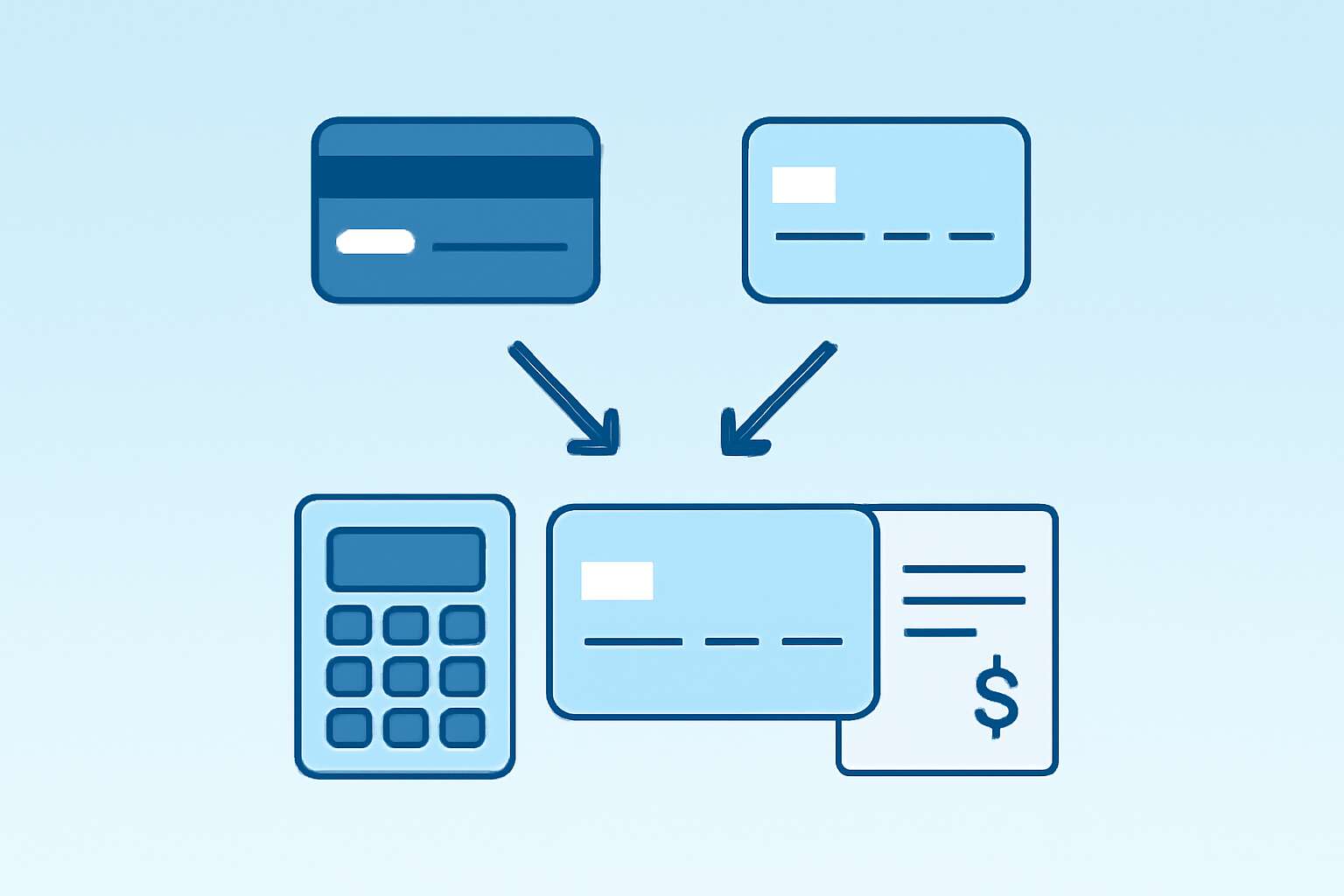
Understanding debt consolidation vs balance transfer
What is debt consolidation and how it works
A single decision can turn a sprawling debt labyrinth into a straight path. In South Africa, understanding debt consolidation vs balance transfer shapes how households approach monthly payments and interest. Debt consolidation pulls multiple debts into one loan; balance transfer moves balances to a fresh card with a promotional rate, like a gleaming doorway through the fog!
Here are the core distinctions, at a glance:
- Debt consolidation pools obligations into one loan with a single payment and fixed terms.
- Balance transfer places existing balances on a new card, often with 0% APR for a promotional window.
- Fees, credit requirements, and repayment schedules shape which option fits best.
Both paths aim to simplify finances and illuminate a clearer horizon, without dictating a rigid future.
What is a balance transfer and how it works
In the heartland where evenings settle over a crossroads, a single decision can redraw a family’s finances. Understanding debt consolidation vs balance transfer lights a path through the monthly grind, guiding households as they weigh interest and payments across South Africa’s unique credit landscape.
With a balance transfer, balances move to a fresh card that often carries a promotional rate, sometimes 0% for a limited time. It can buy breathing room, but watch for fees, eligibility, and when the promotion ends—the clock is always ticking on rate resets.
- Promotional rate window
- Transfer fees
- Credit requirements and payoff timing
Both paths aim to simplify life and restore a sense of horizon, without dictating a rigid future.
Key differences at a glance
Across South Africa, the monthly burden of debt can feel like navigating a storm at dusk. Roughly six in ten households carry unsecured debt, a tide you don’t have to ride alone. Understanding debt consolidation vs balance transfer reveals two routes through the wind of interest rates, fees, and payoff timing.
Here are the key differences at a glance:
- Pathway: debt consolidation wraps multiple debts into one loan, whereas a balance transfer moves balances onto a single new card.
- Cost structure: consolidation loans typically carry fixed rates and one-off fees; balance transfers spotlight promotional rates (often 0%) with transfer fees and a rate clock that can reset after the promo ends.
- Payoff timing: consolidation follows a fixed loan term; balance transfers depend on the promotional window and your repayment cadence.
Both paths aim to smooth the monthly grind and widen the horizon, offering a planet-wide view of your finances without binding you to a rigid timetable.
Cost and fees
Interest rates and APR comparisons
In the arena of debt consolidation vs balance transfer, the real showdown is over cost and interest. “Interest is the price of options,” a SA banker once quipped, and these options come with fixed-rate loans or promotional card offers. Both can simplify payments, but the true price—fees, timing, and the jump when promotional periods end—depends on the lender and your credit history.
Costs and fees can ruin the bottom line. Here are typical components to watch in South Africa:
- Origination or setup fee on a consolidation loan
- Balance transfer fee, often a percentage of the amount moved
- Annual or cardholder fees
- Late payment penalties or early settlement charges
Interest rates and APRs shape the long game. A debt consolidation loan tends to have a fixed APR tied to your credit, while balance transfer cards offer 0% for a promo window before higher rates apply—often into the 20s in SA. Calculate the actual cost after the discount period to see the true value.
Fees to expect with each option
‘Interest is the price of options,’ a SA banker once quipped. In SA, the debate between debt consolidation vs balance transfer hides costs in the fine print—initiation charges for a consolidation loan, a balance-move fee, ongoing annual charges, and penalties that arrive with late or early settlements.
- Initiation or setup charges on consolidation loans
- Balance-transfer fees, often a percentage of the moved amount
- Annual or cardholder maintenance fees
- Penalties for late payments or early settlements
These numbers shape the long game. A consolidation loan carries a fixed rate but upfront costs; a balance-transfer card offers a promotional 0% window with higher rates after, and both require attention to the post-promo reality to determine the true cost within debt consolidation vs balance transfer.
Total cost of repayment over time
‘Interest is the price of options,’ a SA banker quipped. In debt terms, the true cost hides in fine print. When you compare debt consolidation vs balance transfer, the total repayment journey counts.
Promo rates fade and fees arrive. A consolidation loan brings upfront setup costs and a fixed rate; a balance-transfer card offers a 0% window but higher post-promo charges. The total cost is shaped by several charges, including annual fees and penalties for late or early settlements.
- Upfront setup charges
- Balance-transfer fees
- Annual or maintenance fees
- Late-payment penalties
- Early settlement penalties
Over the long run, the option with the lower total repayment wins, even if the monthly payment looks similar at first.
Impact of introductory 0% APR periods
“The introductory 0% period is a theatre of possibilities,” a veteran South African lender told me, and the audience is debt. It lures you forward, but the curtain falls with a price. In SA, more than half carry revolving debt year after year, and every percent matters.
That 0% window can feel relief, yet the post-promo chapter carries sharper terms. A balance-transfer offer can conceal fees or a steeper rate after the clock runs out, while a consolidation loan carries upfront setup costs but a fixed rate. The real math lies in what comes after the grace period: annual fees, late penalties, or early settlement charges that creep into the total you repay.
Ultimately, debt consolidation vs balance transfer rests on the total repayment journey, not the first year’s glow. The longer the horizon, the more essential it is to estimate the ongoing cost rather than the promotional spark.
Eligibility and application process
Credit score and income requirements
Eligibility for either option rests on a few core factors: a stable income, a clear repayment history, and a responsible debt load. For debt consolidation vs balance transfer, South African lenders typically seek affordability, verifiable income, a solid credit score, and a track record of meeting obligations. A strong candidate can show steady earnings and a prudent debt pattern that supports new, manageable payments.
- Steady income and verifiable employment or reliable self-employment income
- Proof of income (payslips, bank statements) and identification
- Details of current debts and monthly obligations to assess overall affordability
Application process: start by gathering docs, then compare offers, then apply online or in person; expect a credit check and a decision within days. If approved, scrutinize the repayment terms to ensure alignment with budget and long-term goals. When choosing between debt consolidation vs balance transfer, the terms must align with income stability and credit considerations.
Required documentation and steps to apply
In South Africa, eligibility for debt consolidation vs balance transfer rests on a stable income, a clear repayment history, and a prudent debt load. Lenders weigh affordability, verifiable earnings, and a track record of meeting obligations; a strong candidate can demonstrate steady earnings and responsible debt management that supports new, manageable payments. I’ve found that clarity on income often translates into confident approvals.
Required documentation helps lenders verify affordability. Gather the following:
- Steady income proof (payslips, salary advices, or verified income statements for self-employment)
- Recent bank statements showing regular income deposits
- Identification and proof of address
- Details of current debts and monthly obligations
The application process typically unfolds online or in person, with a credit check and a decision arriving within days. If approved, borrowers are encouraged to review the repayment terms to ensure alignment with their budget and long-term goals.
Approval timelines and what affects them
Approval timelines in South Africa often swing from days to weeks, but the hinge is clear records and steady income. In the realm of debt consolidation vs balance transfer, eligibility isn’t just a number; it’s a portrait of your financial rhythm—steady earnings, a clean repayment history, and a prudent debt load paint the strongest case.
The application moves quickly when lenders can verify affordability and trustworthiness, and it slows when documentation is spotty or debt commitments are opaque. Here are the factors that influence the pace and outcome:
- Verified income stability and consistency
- Clarity of current debts and monthly obligations
- Speed and completeness of document verification (ID, address, payslips, bank statements)
- How thoroughly the credit check is conducted and lender workload
When these align, decisions arrive with greater confidence and predictability.
Common reasons for denial and how to avoid them
A compass for money: debt consolidation vs balance transfer hinges on a single truth—earnings you can prove, debts you can map, and papers you can trust. Eligibility rides on verified income stability and consistency, clear visibility of current debts and monthly obligations, speed and completeness of document verification (ID, address, payslips, bank statements), and how thoroughly the credit check is conducted. When these signals align, approvals glide in with confidence and a future that’s easier to navigate.
Common reasons for denial and how to avoid them:
- Inconsistent or unverifiable income that lenders can’t confirm
- Unclear current debts or high monthly obligations that squeeze repayment capacity
- Missing or late documents (ID, address verification, payslips, bank statements)
- Short credit history or recent, heavy credit inquiries
With careful preparation and tidy records, the path toward approval stays steady rather than stalling in uncertainty.
Repayment strategies and plan options
Term lengths and how they affect payoff speed
In the clash of debt consolidation vs balance transfer, repayment strategies become the metronome of progress. Shorter terms propel higher monthly payments but sprint you toward payoff, while longer terms ease the burden and stretch the clock. In South Africa’s financial landscape, the tempo you choose shapes your overall freedom and peace of mind.
Consider these term-length options to tailor payoff speed:
- Short-term plan (12–18 months) for rapid closure
- Mid-term plan (24–36 months) for a balance of speed and breathing room
- Long-term plan (48–60 months) to ease cash flow during tight seasons
Whatever path you pick, the alignment of payments with life’s irregularities—income cycles, expenses, and emergencies—will guard your financial harmony and keep the conversation with lenders clear as you move forward!
Budget-aligned repayment planning
Across South Africa, more than a quarter of households carry debt, a drumbeat that never quite eases. Repayment strategies act as a metronome, tempering the wild tempo of irregular income, seasonal bonuses, and unexpected expenses. When choosing debt consolidation vs balance transfer, you pick a rhythm rather than a miracle. Budget-aligned planning shapes how quickly the balance dwindles and how freely you breathe, even when life throws a curveball.
Budget-aligned repayment planning treats money like a living tide—rising on payday and easing through lean weeks. It brings consistent cadence, cushions shocks with a quiet emergency margin, and keeps the conversation with lenders clear as circumstances shift. The outcome is a cadence that preserves dignity and a sense of control, turning pressure into progress.
Effect on monthly payments depending on your balance
Across South Africa, more than a quarter of households carry debt, and repayment strategies act as a metronome—steady, if not dramatic. When weighing debt consolidation vs balance transfer, monthly payments hinge on balance size, interest, and term. A higher balance raises the outlay; a leaner balance buys breathing room.
Plan options vary to fit different cashflows without pretending miracles exist. Consider options that simplify cadence, such as a single monthly payment and a fixed term to provide predictability or a balance-transfer window that discourages new spending while you clear the ledgers.
- Single monthly payment to simplify budgeting
- Fixed term to lock in payoff pace
- Flexible top-up handling if income fluctuates
As balances swell or shrink, the monthly obligation shifts, reaffirming that rhythm matters as much as rate, and that patience tends to outpace panic in the long run.
Strategies to accelerate debt payoff
In South Africa’s small towns and sun-worn kitchens, repayment becomes more than a math problem—it’s a rhythm you live by. When we compare debt consolidation vs balance transfer, the question isn’t only about rates; it’s about fitting a plan to daily life so payments stay manageable and worry stays at bay.
Consider these strategy angles:
- An avalanche strategy: focus on the highest-interest debt first to shrink long-term costs.
- Milestone tracking keeps motivation alive without fixating on a single target.
- Padding a small emergency fund helps weather surprises and keeps payments on track.
These options help you breathe while paying down debt, offering a tempo that matches your community’s lived reality.
When it makes sense to refinance or consolidate again
Refinancing or consolidating again isn’t a gamble; it’s a recalibration of your monthly rhythm. In South Africa’s sunlit towns, a smart adjustment can turn pressure into predictability. When weighing debt consolidation vs balance transfer, the key isn’t chasing the lowest payment today but lowering the total cost over time.
Look at the math and your budget reality. If a fresh loan or new card promises a lower all-in cost after fees and keeps the payoff window realistic, it could fit your life. In that moment, debt consolidation vs balance transfer becomes a practical decision, not a speculative dream.
- Lower total interest and fees after considering the term and closing costs
- Credit utilization and score impact from a new plan
- Alignment with cash flow and daily expenses
If the math doesn’t add up, hold steady and revisit during the next rate cycle.
Risks, traps, and best practices
Common pitfalls to avoid
Debt is a language—learn its grammar before you sign. When weighing debt consolidation vs balance transfer, the glittering promos can mask real costs and timing traps that bite after the honeymoon ends. In South Africa, success hinges on rate structure, fees, and discipline, not magic.
- Hidden fees and transfer costs
- Promos that expire and trigger higher rates
- New spending on the unsecured line during the plan
Best practices to stay savvy: compare total payoff, lock in a realistic repayment timeline, and autopay to avoid missed payments. Remember that the right option works best when you tackle habits, not only balances.
Keeping new debt from creeping in
Debt is a language with real consequences, and South Africans know the risk. The glittering promos around debt consolidation vs balance transfer often glitter more than they reveal. The real test is how rates, fees, and discipline play out long after the honeymoon ends. Beware—the rhetoric is loud; the truth hides in the numbers.
Risks and traps aren’t abstract. When weighing debt consolidation vs balance transfer, look beyond the teaser: hidden fees and transfer costs; promos that expire and trigger higher rates; and new spending on the unsecured line during the plan.
- Hidden fees and transfer costs
- Promos that expire and trigger higher rates
- New spending on the unsecured line during the plan
These elements quietly tilt the total payoff.
Best practices to stay savvy emphasise clarity over hype: focus on the total payoff, maintain a plausible repayment horizon in mind, and keep payments consistent to avoid slips.
Understanding terms, fees, and fine print
Debt promises glitter; the price shows up in the fine print. When weighing debt consolidation vs balance transfer, you glimpse the romance in the promo—but the true x-ray is the agreement: rates, term lengths, and the penalties that hide in footnotes.
Let the total picture unfold in the fine print: how rates may reset, what transfer fees lurk, and where new spending might quietly creep during the plan. The fine print isn’t adversarial; it’s your compass in a crowded market, guiding you through the South African financial landscape as you consider debt consolidation vs balance transfer.



0 Comments